
Mobilizing Private Capital for the Climate Transition
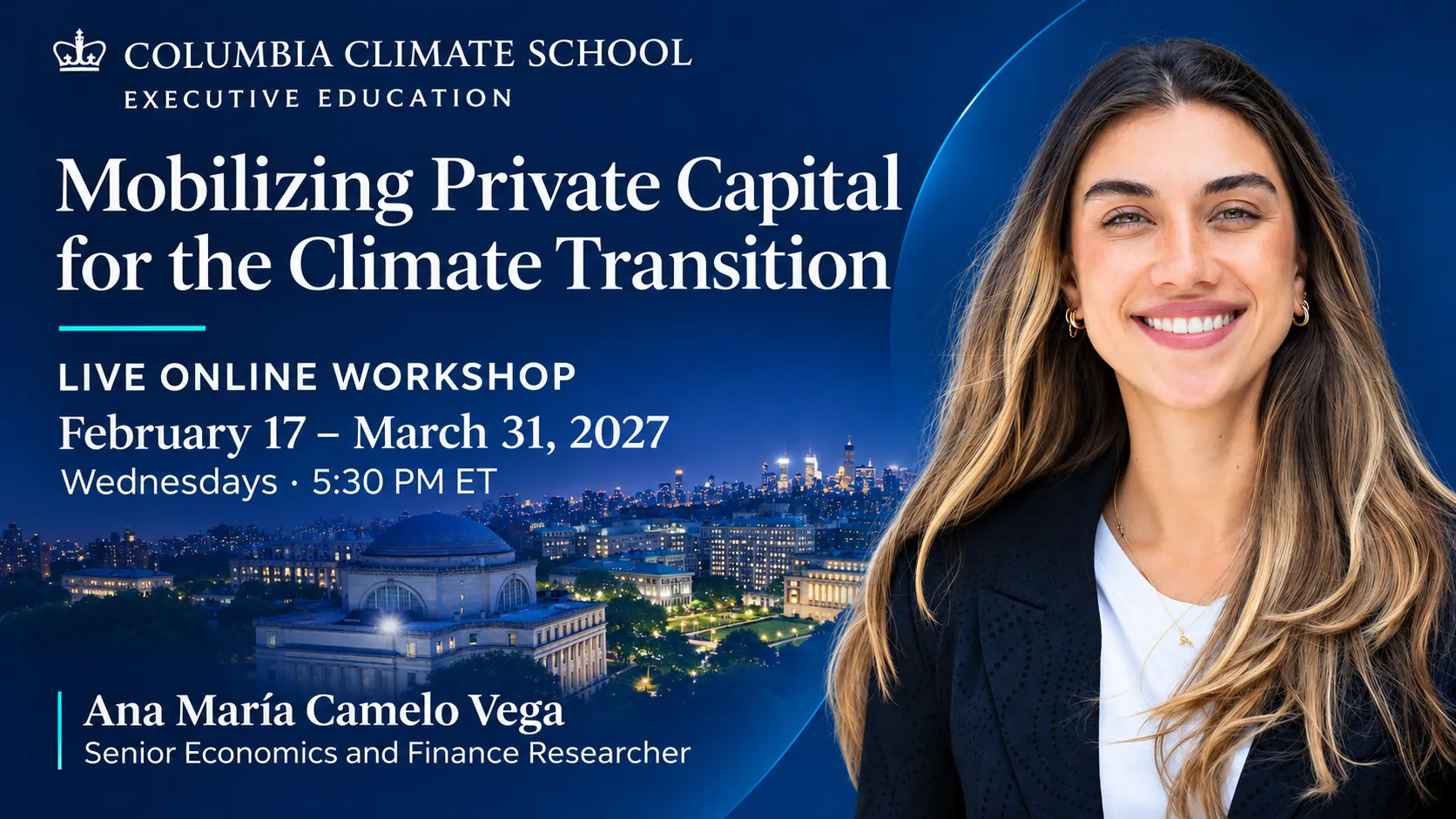
Description:
Developing countries need trillions of dollars a year to build clean power, upgrade grids, and adapt to a warming climate, but governments and aid budgets can cover only a fraction of that cost. The rest has to come from banks, pension funds, insurers, and other private investors. That is the premise behind almost every climate finance pledge of the past decade. Unfortunately this approach is not working and the money actually reaching these projects is only a small share of what was promised. The obstacles behind this shortfall are structural. Investors and development finance staff are handed a toolkit — guarantees, blended finance, first-loss capital — that is rarely explained precisely and routinely oversold. In this workshop, participants will work through this toolkit and leave able to take a financing problem apart: read a capital structure, separate real risk from mispriced risk, locate who absorbs it, and judge whether a proposed structure moves a transaction or merely relabels it.
Over 15 hours of live instruction, participants develop a working command of how climate and transition projects in emerging markets are financed, and why so many are not. The workshop moves through the sequence that determines outcomes: what private capital can and cannot finance, what each type of investor is permitted to do under its own mandate, how bankability is manufactured rather than discovered, why the same asset costs two or three times more to finance in one market than another, and which de-risking instruments genuinely move a transaction versus which simply relabel it.
The treatment is practical and evidence-based rather than promotional. Blended finance, guarantees, labeled bonds, and mobilization ratios are assessed against their track record. Each session pairs a working lecture with applied work on live and recent transactions, including deals participants bring from their own institutions. The workshop closes with a structuring clinic in which participants run a full diagnostic on a financing problem of their own. Participants leave able to read a capital structure, identify where risk lies and who absorbs it, and assess whether a proposed arrangement will do what its sponsors claim.
Learning objectives/themes:
- What Private Capital Can and Cannot Finance. Apply a consistent sort to any financing problem, distinguishing revenue-generating assets from public and global public goods, and separating what is genuinely bankable from what will require concessional or public funding no matter how it is structured. This diagnostic runs through every subsequent session and is the discipline the workshop is built around.
- Mandates, Instruments and the Manufacture of Bankability. Map who holds capital and what each holder is permitted to do with it, from commercial banks and asset owners to insurers, DFIs, MDBs and export credit agencies, and understand how offtake structures, revenue certainty, tenor, regulation and demand aggregation turn an unfinanceable project into an investable one.
- Diagnosing the Cost of Capital. Disaggregate what is bundled together as emerging market risk into currency, political, offtake, liquidity, construction and technology risk, and analyze how sovereign ceilings, rating methodology, and prudential treatment raise financing costs across an entire economy, so that participants can distinguish real risk from mispriced and architectural risk.
- Instruments for Risk Transfer, and What the Evidence Shows. Assess concessional capital, first-loss tranches, guarantees, political risk insurance, currency solutions, and aggregation vehicles against a single test, namely whether an instrument reduces risk, redistributes it, or compensates for it, and evaluate blended finance and adjacent instruments against actual mobilization performance rather than headline ratios.
Who this workshop is intended for:
This workshop is designed for mid- to senior-level professionals on both sides of the mobilization question. On the private side, that includes investment and credit teams at commercial and investment banks, asset owners and managers, infrastructure and energy funds, insurers, project developers, corporate treasury and strategy teams, and the legal and financial advisors who structure these transactions. On the public and multilateral side, it is built for staff at multilateral development banks, bilateral development finance institutions, export credit agencies, and climate funds working on private-sector mobilization, guarantees, blended structures, or country engagement, as well as government officials in finance, energy, and mining ministries who negotiate with these counterparties.
Participants will get the most from the workshop if they have some professional exposure to investment, lending or project finance, though this is not a prerequisite. No specialized climate knowledge or quantitative prerequisite is required. The workshop assumes a working audience and is structured so that participants can bring their own transactions into the applied sessions.
Learning modalities:
This workshop will be offered in a live virtual format via Zoom, incorporating a blend of lectures, case studies, and interactive discussions. Course delivery is synchronous to facilitate peer interaction and networking. Please note that all courses are taught in English. Proficiency in written and spoken English is required.
Schedule:
VIRTUAL, Wednesdays, February 17 to March 31, 2027. Session 1 will be 2 hours in length. All other sessions will run for 2 hours and 10 minutes.
Session 1: February 17, 5:30-7:30 pm ET
Session 2: February 24, 5:30-7:40 pm ET
Session 3: March 3, 5:30-7:40 pm ET
Session 4: March 10, 5:30-7:40 pm ET
Session 5: March 17, 5:30-7:40 pm ET
Session 6: March 24, 5:30-7:40 pm ET
Session 7: March 31, 5:30-7:40 pm ET

Instructor Bio:
Ana María Camelo Vega is a Senior Economics and Finance Researcher at the Columbia Center on Sustainable Investment (CCSI), where she leads work on international climate finance, with a focus on emerging markets. Her work sits at the intersection of finance, economics, and sustainability, with a focus on mobilizing finance for the energy transition and advancing the SDGs. She has led research and advisory projects across Africa, Asia and the Pacific, Latin America and the Caribbean, and Europe, working with public, private, and institutional financial actors. She co-teaches International Climate Finance at the Columbia Climate School and teaches on financing the transition in resource-rich economies through Columbia’s executive training programs.
Previously, she worked at Finance in Motion, managing technical assistance projects supporting sustainable finance and green, social, and sustainability-linked bond markets across Latin America. She has also served as an economic adviser to Colombia’s Ministries of Environment and Sustainable Development and Housing, Cities, and Territory. Ana María holds an MSc in Public Policy from NYU and bachelor’s degrees in Applied Economics and Global Studies from the College of St. Scholastica.