Start Your Climate School Journey!
We appreciate your interest in Columbia Climate School, and we look forward to getting to know you!
The Master of Science (MS) in Climate Finance is a one-year, 39-credit professional degree program offered by the Columbia Climate School in close collaboration with the Columbia Business School. This interdisciplinary degree integrates climate science with fundamental financial management practices that equip students with the financial decision-making skills to respond to climate change.


Students take courses in climate science, adaptation and mitigation strategies, capital markets, corporate finance, energy and infrastructure financing, legal and regulatory frameworks, and more. Students will study in New York, the world’s leading financial hub, with regular interaction with top-tier practitioners from finance and industry.
The program meets a growing market need within banking, asset management, insurance, consulting, and other financial industries looking to assess risks and opportunities associated with climate change, as well as within global multilateral institutions, intergovernmental organizations, and the public sector, all of which are mobilizing the trillions of dollars needed for climate mitigation and adaptation.

Lisa Sachs, Associate Professor of Professional Practice; Director, Columbia Center on Sustainable Investment; Director, MS in Climate Finance
The MS in Climate Finance’s integrated curriculum enables students to:
- Understand the science of climate change and its varying economic, social, and environmental impacts.
- Translate the implications of climate research into appropriate financial and business language and decision-making.
- Assess risks and opportunities associated with climate change.
- Evaluate the financial tools and strategies that can be applied to accelerate the energy transition and to finance critical investments in mitigation and adaptation.
- Understand investor strategies for financing climate solutions in the context of a carbon-constrained global economy, emerging technologies, and national and international policy developments.
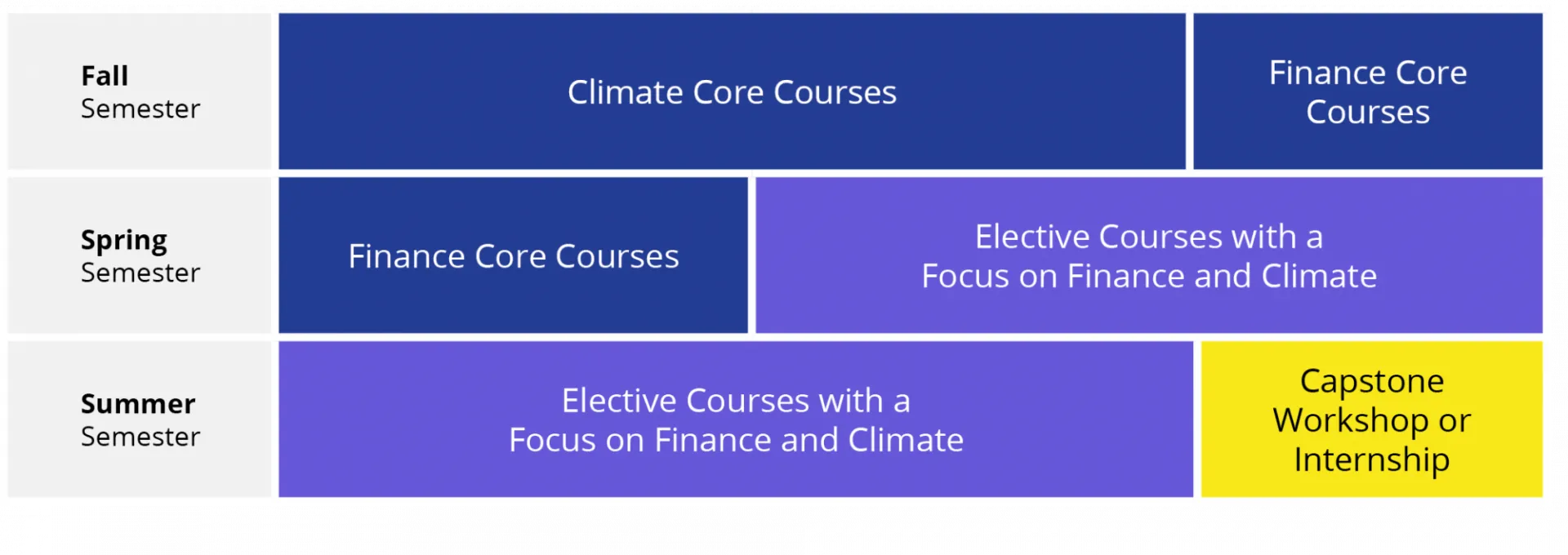
Core Courses
Practical and Applied Experiences
Students gain practical skills and experience during the final semester by completing a culminating internship or capstone project.
Public and private climate finance doubled between 2020 and 2023, but exponentially more investment is needed to meet global emissions reduction goals and adaptation needs. There is an urgent need for trained professionals who can apply their climate knowledge to financial decision-making, ensuring that capital is invested quickly and effectively.
Graduates will become key decision-makers in public and private institutions, driving impactful solutions to the climate crisis through advanced financial tools and knowledge. Graduates can expect to find employment in financial institutions (public and private), businesses, consulting firms, intergovernmental organizations, ministries of finance, non-governmental organizations, and more.
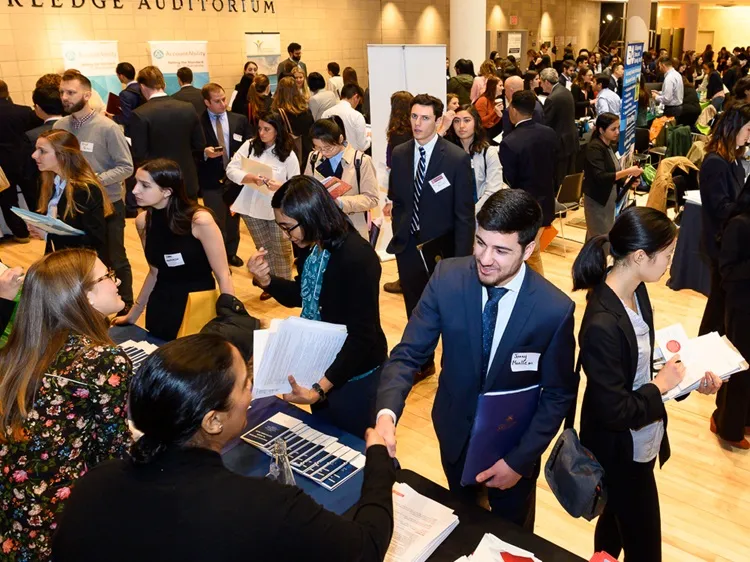
The Career Management Office supports Climate School students as they prepare for and obtain professional opportunities. From enrollment to employment, our staff provide services and programming that contribute to the growth and development of each student. Career management staff are also continually forging strategic industry partnerships so that students are exposed to a broad range of opportunities in climate and finance.
Curriculum at a Glance